



Introduction
Swimming competitions can seem overwhelming at first. Many swimmers are unsure about the different competition levels, race formats, qualifying times, and meet-day procedures. Parents often have similar questions, especially when their child enters a swim meet for the first time. It is normal to feel nervous when you do not know what to expect or how competitive swimming works.

One thing that becomes clear after spending time around swim meets is that most first-time competitors share the same concerns. They worry about making mistakes, missing an event, or feeling unprepared. The good news is that swimming competitions follow a structured format, and once you understand the basics, the process becomes much easier. Learning how competitions work can help you feel more confident and enjoy the experience from the moment you arrive at the pool.
What Are Swimming Competitions?
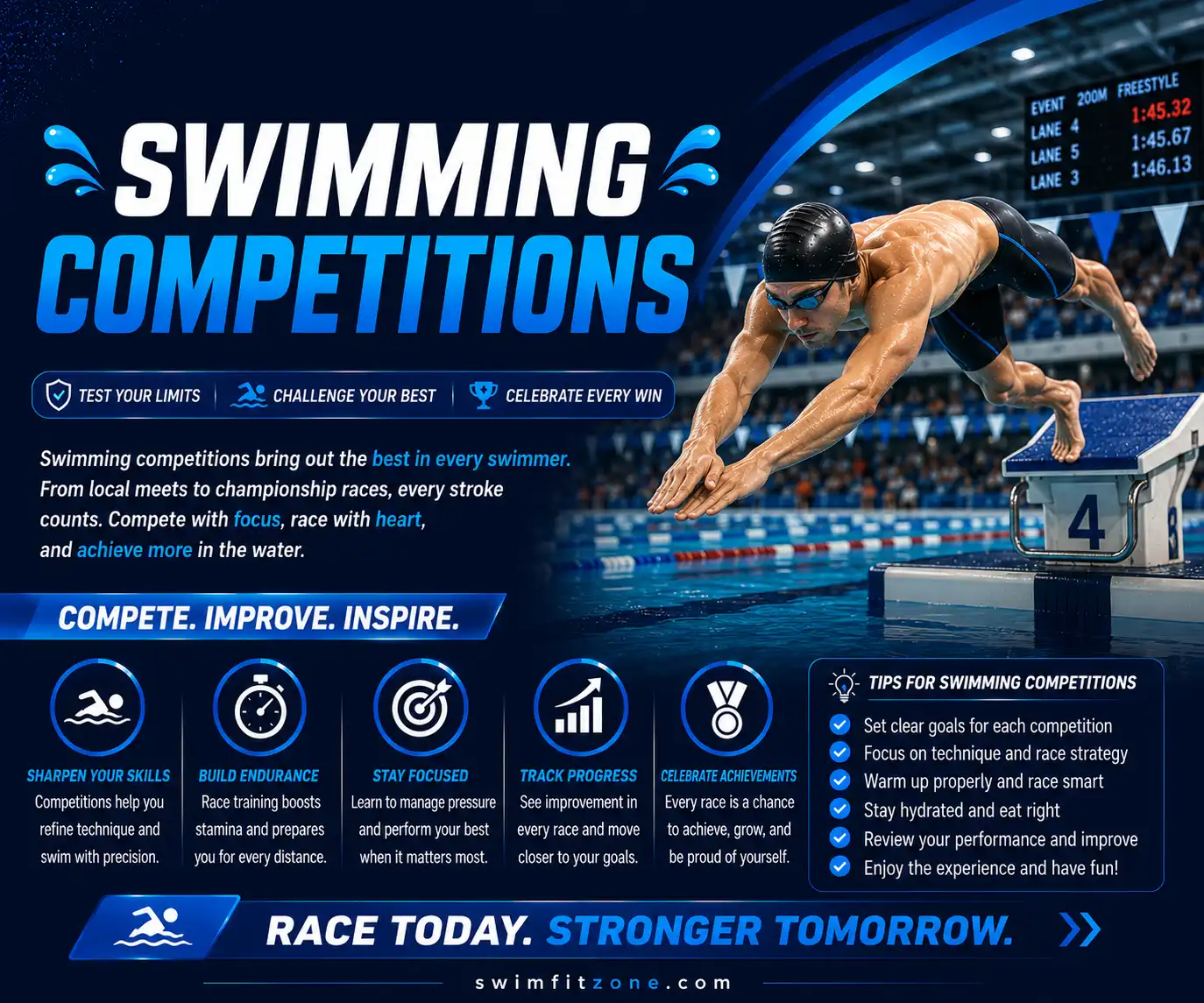
Swimming competitions are organized events where swimmers race against each other in different strokes and distances. These events can take place in swimming pools or open water locations such as lakes, rivers, and oceans.
Some competitions are designed for beginners, while others are meant for elite athletes. Regardless of skill level, every competition follows a set of rules to ensure fair racing.
Purpose of Swimming Competitions
Swimming competitions serve several purposes:
- Measure a swimmer’s performance
- Improve race experience
- Track progress over time
- Build confidence
- Qualify for higher-level events
Many swimmers use competitions as a way to test the skills they practice during training.
Who Can Participate in Swimming Competitions?
Swimming competitions are open to many groups, including:
- Beginner swimmers
- Club swimmers
- High school athletes
- College athletes
- Masters swimmers
- Professional swimmers
Most swimmers start with local competitions before moving to larger events.
Benefits of Competitive Swimming
Regular competition and training can help swimmers build swimming endurance and improve overall performance. Competitive swimming offers several benefits:
- Better swimming technique
- Improved endurance
- Faster race times
- Stronger discipline
- Increased confidence
Many swimmers also enjoy the friendships and teamwork that come from participating in swim meets.
Types of Swimming Competitions
Swimming competitions come in different formats. Each type offers unique challenges and opportunities.

Pool Swimming Competitions
Pool competitions are the most common type of swim meet.
Features include:
- Individual races
- Relay events
- Timed races
- Standardized rules
Most beginner swimmers start with pool competitions.
Open Water Swimming Competitions
Open water competitions take place outside traditional pools.
Common locations include:
- Lakes
- Rivers
- Oceans
These events often involve longer distances and changing water conditions.
Some open water swimming events may require specialized equipment depending on water temperature and race conditions.
Relay Competitions
Relay races involve teams instead of individual swimmers.
Popular relay formats include:
- Freestyle Relay
- Medley Relay
Each swimmer completes part of the race before the next teammate begins.
High School Swimming Competitions
High school swimmers represent their schools in individual and team events.
These competitions often lead to regional and state championships.
College Swimming Competitions
College swimming is highly competitive and features some of the best young swimmers.
Many college athletes compete at national-level events.
Masters Swimming Competitions
Masters competitions are designed for adult swimmers.
They provide opportunities for:
- Fitness swimmers
- Former competitive swimmers
- Adults returning to the sport
International Swimming Competitions
International competitions bring together swimmers from different countries.
Examples include:
- Olympic Games
- World Championships
- World Cup events
Age Group Competitions
Most swim meets divide swimmers into age groups.
Common age categories include:
- 8 and under
- 9-10
- 11-12
- 13-14
- 15-18
- Adult Masters
Age groups help create fair competition by matching swimmers with others at a similar stage of development.
Competition Levels in Swimming
Most swimmers progress through several competition levels as their skills improve.

1. Local Swim Meets
Local meets are usually the first competitions swimmers enter.
Benefits include:
- Low-pressure environment
- Valuable race experience
- Beginner-friendly atmosphere
2. Invitational Meets
Invitational meets bring together swimmers from different clubs and teams.
Competition is usually stronger than local meets.
3. Regional Championships
Regional championships feature swimmers from a larger geographic area.
Some events may require qualifying standards.
4. State Championships
State-level competitions include many of the top swimmers within a state.
These meets are often highly competitive.
5. Sectional Championships
Sectionals are designed for advanced swimmers who have achieved specific qualifying times.
6. Futures Championships
Futures competitions help developing swimmers prepare for national-level events.
7. Junior National Championships
Junior Nationals feature many of the best young swimmers in the country.
8. National Championships
National championships showcase elite swimmers competing at the highest domestic level.
9. Olympic Trials
Olympic Trials determine which swimmers earn positions on the Olympic team.
10. Olympic Games
The Olympic Games represent the highest level of competitive swimming.
Many advanced competitions follow qualification standards similar to those used in official USA Swimming events.
What Are Qualifying Times?
Not every competition is open to all swimmers.
Many championship events require qualifying times, also called time cuts.
A qualifying time is a performance standard that swimmers must achieve before entering a competition.
Key points:
- Common in championship meets
- Based on previous race performances
- Help maintain competition standards
- Become more challenging at higher levels
Local swim meets often allow open entry, while elite competitions usually require qualification.
Swimming Competition Progression
- Local Swim Meets
- Invitational Meets
- Regional Championships
- State Championships
- Sectional Championships
- Futures Championships
- Junior National Championships
- National Championships
- Olympic Trials
- Olympic Games
How Swimming Competitions Work
Although every meet is slightly different, most follow the same basic process.

1. Registration and Event Entry
Swimmers register for the competition and choose the events they want to enter.
Event selection often depends on:
- Age
- Skill level
- Qualifying standards
- Coaching recommendations
2. Check-In Procedures
Some competitions require swimmers to confirm participation before the event begins.
Missing check-in deadlines can result in removal from an event.
3. Warm-Up Sessions
Warm-ups help swimmers prepare both physically and mentally. Following proper swimming warm-up routines can loosen muscles, improve mobility, and reduce the risk of injury before racing.
Benefits include:
- Loosening muscles
- Practicing starts and turns
- Becoming familiar with the pool
4. Heat Assignments
Swimmers are placed into heats before racing.
Heat assignments are often based on:
- Entry times
- Age groups
- Competition rules
5. Race Starts
Each race begins with an official start signal.
Swimmers must:
- Follow starting procedures
- Remain still before the start
- React legally to the signal
6. Results and Rankings
Race times determine rankings.
Results are usually posted:
- On a results board
- Through mobile apps
- On the competition website
7. Award Ceremonies
Many competitions recognize top performers with:
- Medals
- Ribbons
- Trophies
Championship events may also award team titles.
What to Expect at Your First Swimming Competition
Before arriving at a swim meet, make sure you have all the necessary equipment. Many swimmers wear swim caps for competitions to reduce drag and improve comfort in the water. It is also important to bring a reliable pair of swimming goggles so you can see clearly throughout your races.
Most swimmers will:
- Arrive early
- Check in
- Attend warm-ups
- Wait for event announcements
- Report to their assigned area
- Race in their heat
- Review results afterward
A few tips for first-time competitors:
- Arrive early
- Listen carefully to announcements
- Follow your coach’s instructions
- Stay hydrated
- Focus on learning rather than winning
Most swimmers feel much more comfortable after participating in their first few competitions.
Common Swimming Events and Distances
Swimming competitions include a variety of strokes and race distances. Swimmers can choose events based on their strengths, experience, and goals. Each competitive swimming stroke has its own rules, techniques, and race distances.

Freestyle Events
Freestyle is the most popular stroke in competitive swimming. Improving your freestyle swimming technique can help you swim more efficiently and achieve faster race times.
Common freestyle distances include:
- 50m
- 100m
- 200m
- 400m
- 800m
- 1500m
Backstroke Events
Backstroke races are performed while swimming on the back. A strong backstroke technique is important for maintaining speed and body position during competition races.
Common distances include:
- 50m
- 100m
- 200m
Breaststroke Events
Breaststroke is known for its unique pull and kick pattern.
Common distances include:
- 50m
- 100m
- 200m
Butterfly Events
Many swimmers spend extra time refining their butterfly stroke technique because it is one of the most physically demanding events.
Common distances include:
- 50m
- 100m
- 200m
Individual Medley Events
Individual Medley, often called IM, combines all four competitive strokes in one race.
Stroke order:
- Butterfly
- Backstroke
- Breaststroke
- Freestyle
Common distances:
- 200m IM
- 400m IM
Relay Events
Relay races involve teams of swimmers.
Popular relay formats:
- 4×100 Freestyle Relay
- 4×200 Freestyle Relay
- 4×100 Medley Relay
Understanding Heats, Finals, and Relays
Large swimming competitions use different race formats to determine winners.
What Is a Heat?
A heat is a preliminary race used to organize swimmers into groups.
Large competitions may have several heats for the same event because too many swimmers cannot race at once.
What Is a Final?
A final is the race that determines the overall winners.
In many championship meets:
- Swimmers compete in heats first
- The fastest swimmers advance
- Winners are decided in the final race
If you are new to competitive swimming, learning more about common swim meet formats and event structures can help you understand how races are organized and how winners are determined.
How Relay Events Work
Relay events involve teams of swimmers.
Each swimmer completes a section of the race before the next teammate enters the water.
Relay success depends on:
- Individual speed
- Team coordination
- Legal exchanges
Team Scoring Systems
Many competitions award points based on finishing positions.
Points earned by swimmers contribute to the team’s overall score.
The team with the highest score at the end of the meet is declared the winner.
How Long Does a Swim Meet Last?
The length of a swim meet depends on:
- Number of swimmers
- Number of events
- Competition format
- Competition level
Typical durations:
- Local meets: 2-4 hours
- Invitational meets: 4-8 hours
- Championship meets: Multiple days
Knowing the schedule ahead of time helps swimmers and parents prepare properly.
Competition Pool Types
Competitive swimming uses different pool lengths depending on the event.
Short Course Yards (SCY)
Features:
- Length: 25 yards
- Common in the United States
- Frequently used for school and club competitions
Short Course Meters (SCM)
Features:
- Length: 25 meters
- Used in some national and international events
Long Course Meters (LCM)
Features:
- Length: 50 meters
- Used for Olympic and World Championship competitions
Olympic swimming competitions are held in 50-meter pools, also known as long course pools.
Pool Features Used in Competitions
Competition pools often include:
- Starting blocks
- Lane ropes
- Timing systems
- Touchpads
- Backstroke flags
These features help create accurate and fair races.
Swimming Competition Rules
Swimming competitions follow strict rules to ensure fair competition.
Stroke Rules
Each stroke has specific requirements.
Officials monitor races to ensure swimmers use proper technique.
Turn Rules
Turns must follow the rules of the specific stroke.
Incorrect turns can result in penalties or disqualification.
Starting Rules
Swimmers must react correctly to the starting signal.
False starts may lead to disqualification.
Relay Exchange Rules
Relay swimmers must wait until their teammate touches the wall before leaving the starting block.
Leaving early is considered a relay violation.
Why Swimmers Get Disqualified
Common reasons include:
- False starts
- Illegal turns
- Incorrect stroke technique
- Missing a required wall touch
- Early relay exchanges
Understanding these rules helps swimmers avoid costly mistakes.
Major Swimming Competitions Around the World
Several major competitions bring together the world’s best swimmers.

Olympic Games
The Olympic Games are the most prestigious swimming competition.
Top swimmers from around the world compete for Olympic medals.
World Championships
World Championships feature elite swimmers representing their countries.
These competitions are held between Olympic Games.
World Cup Series
The World Cup Series consists of multiple meets held throughout a season.
Swimmers earn points based on performance across events.
National Championships
National championships determine the top swimmers within a country.
These meets often serve as qualifying events for international competitions.
NCAA Championships
NCAA Championships feature some of the best college swimmers.
Many future Olympians compete at this level.
Masters Championships
Masters championships provide competitive opportunities for adult swimmers.
These events focus on age-group racing and lifelong participation.
What Parents Should Know Before a Swim Meet
Parents play an important role in helping young swimmers enjoy competitions.
Helpful tips include:
- Arrive early
- Bring extra towels
- Pack water and healthy snacks
- Review the event schedule
- Support effort rather than results
Swimming competitions often involve waiting between races, so preparation helps make the day smoother.
Common Mistakes First-Time Competitors Make
New swimmers often make mistakes that can affect their performance.
Arriving Late
Late arrival can cause unnecessary stress and reduce preparation time.
Skipping Warm-Ups
Warm-ups prepare the body for racing and should not be missed.
Ignoring Event Schedules
Swimmers should always know when their events are approaching.
Poor Race Preparation
Common preparation mistakes include:
- Not drinking enough water
- Poor sleep
- Forgetting equipment
- Losing focus before races
Avoiding these mistakes can improve the competition experience.
How Beginners Can Get Started in Swimming Competitions
Getting started is easier than many people think.
Join a Swim Club
Swim clubs provide:
- Coaching
- Structured training
- Competition opportunities
Practice Competitive Strokes
Learning proper technique is important before entering competitions.
Focus on:
- Freestyle
- Backstroke
- Breaststroke
- Butterfly
Enter Local Meets
Local competitions provide valuable experience in a supportive environment.
They are ideal for first-time competitors.
Set Realistic Goals
Good beginner goals include:
- Finishing a race successfully
- Improving personal best times
- Learning competition procedures
- Building confidence

Final Thoughts
Swimming competitions give swimmers a chance to test their skills, track their progress, and gain valuable experience in a competitive environment. While race results are important, the biggest benefits often come from the lessons learned through preparation, practice, and participation. Every meet helps swimmers become more comfortable, confident, and focused.
Many successful swimmers did not begin their journey by winning races. They started by learning the rules, understanding the competition format, and gaining experience one event at a time. Whether your goal is to improve personal best times, compete at higher levels, or simply enjoy the sport, each swimming competition is another step forward in your development as a swimmer.

