



Introduction
Swimming freestyle can feel simple, but many swimmers struggle. Maybe your hips sink, your arms cross the centerline, or you get tired too fast. I know this because I’ve coached and swum freestyle for years. Beginners get frustrated, and competitive swimmers lose seconds due to small mistakes.
This guide shares Freestyle Swimming Tips that really work. Freestyle is one of the four main competitive swimming strokes, each with its own technique and purpose. Our Swimming Stroke Techniques guide explains the key differences between these strokes and how they are used in training, fitness swimming, and competition. You’ll learn how to improve body position, breathing, arm technique, and leg kick. I’ll also share drills and workouts I’ve used personally and with swimmers I’ve trained. By the end, you’ll feel more confident, faster, and in control in the water.

What Is Freestyle?
Freestyle is a stroke where you float on your stomach. Your arms move in a circular motion, and your legs flutter from the hips. Breathing is done to the side. Freestyle is used in races, fitness swimming, and triathlons.
Important Elements of Freestyle

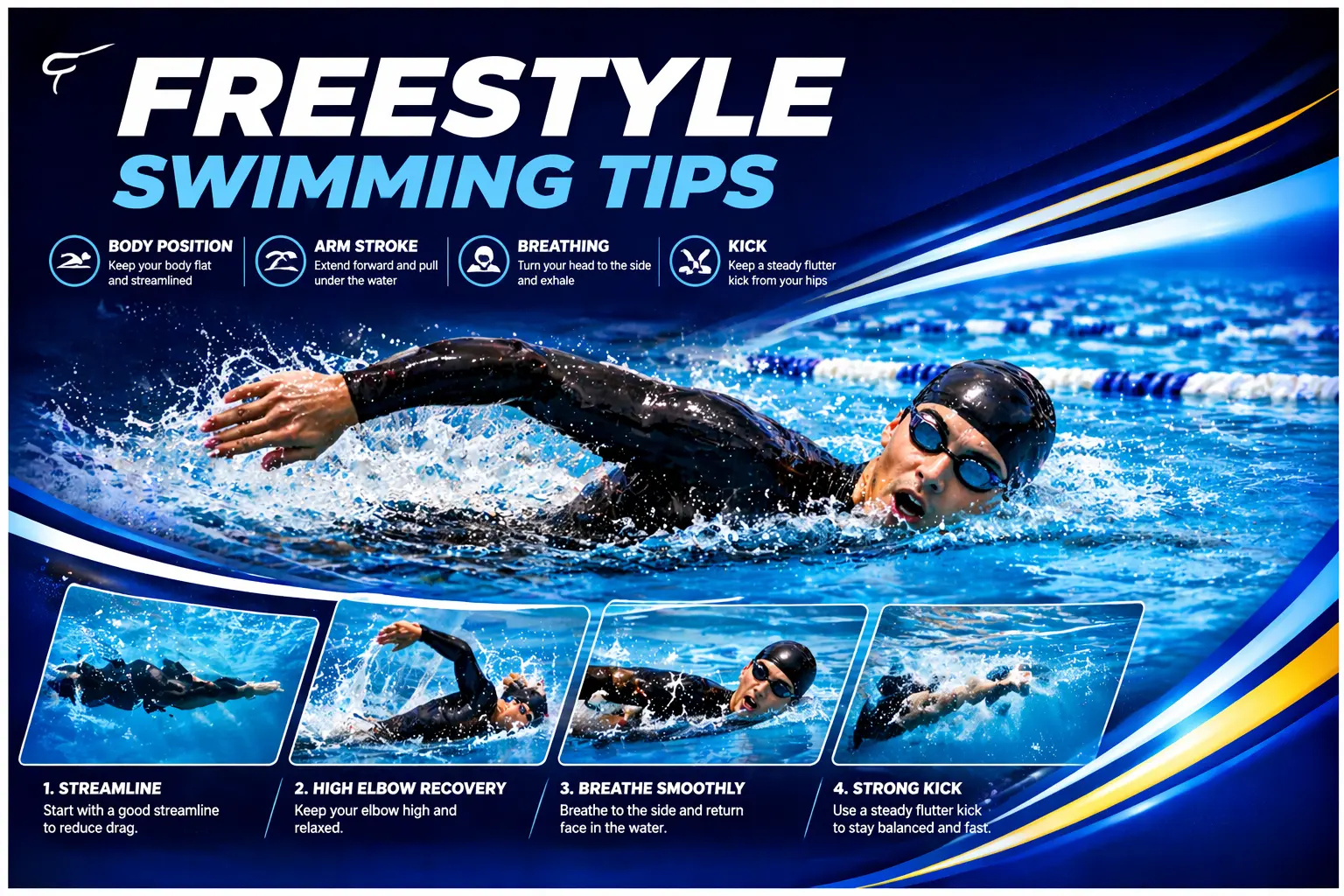
Good freestyle depends on body position, arm technique, leg kick, and breathing.
Head Position: Keep your head straight. Look slightly forward, not too high. Avoid lifting your chin.
Body Alignment: Keep your body flat with hips near the surface. Rotate shoulders and hips with each stroke.
Arm Technique: High elbow pull underwater. Push water back toward your hips. Enter water in line with your shoulder.

Leg Kick: Flutter kick from your hips, not knees. Keep legs relaxed.

Breathing: Turn your head to the side, inhale quickly, exhale underwater fully.
Common Freestyle Mistakes
- Head too high
- Hips sinking
- Crossing arms over the midline
- Overkicking or stiff legs
- Poor timing of strokes and breathing
Correcting these mistakes takes time and repetition. Focusing on small adjustments during practice is one of the most effective ways to achieve long-term Swimming Technique Improvement and become a more efficient swimmer.
Advanced Stroke Mechanics
- Hand Entry: Enter in line with shoulders, pinky/thumb first.
- High Elbow Pull: Bend elbow underwater, push water back toward hips.
- Push Phase: Finish stroke with a strong push past your hip.
Body Rotation Timing
Rotate shoulders and hips with each stroke. As one arm enters, rotate slightly toward that side. This improves reach, reduces drag, and increases power.
Drills to Improve Freestyle
Regular practice drills help swimmers improve timing, body position, and stroke efficiency. Many of the exercises below are commonly used in structured Swimming Stroke Drills sessions to build better technique and consistency.
- Single Arm Drill : Focus on one arm at a time.
- Catch-Up Drill : Improves stroke timing and coordination.
- Flutter Kick Drill : Use a kickboard for fast small kicks.
- Freestyle with Fins : Improves kick power and body feel.
- 6-Kick Switch Drill : Strengthens rhythm and rotation.
- Double-Arm Drill : Swim both arms together for stroke path.
- Shoulder Roll Drill : Roll shoulders while keeping hips steady.
- Bilateral Breathing Drill : Alternate sides for balance and efficiency.
Freestyle Drills Summary
| Drill / Set | Purpose | Distance / Reps | Notes |
|---|---|---|---|
| Single Arm Drill | Arm pull & rotation | 2 × 50m | Swim with one arm only |
| Catch-Up Drill | Timing & coordination | 2 × 50m | Other arm extended |
| Flutter Kick Drill | Leg power & rhythm | 4 × 25m | Use kickboard |
| 6-Kick Switch Drill | Rhythm & rotation | 4 × 25m | 6 kicks per stroke cycle |
| Double-Arm Drill | Stroke path & balance | 2 × 50m | Both arms together |

Freestyle Workouts

Beginner Session:
- Warm-up: 4 × 25m easy swim
- Drills: 2 × 50m single arm
- Main Set: 4 × 50m freestyle at steady pace
- Cool Down: 2 × 25m easy kick
Intermediate Session:
- Warm-up: 4 × 50m easy
- Drills: 4 × 25m catch-up + single-arm
- Main Set: 6 × 50m moderate pace, 15s rest
- Sprint Set: 4 × 25m fast
- Cool Down: 2 × 50m easy
Advanced Session:
- Warm-up: 8 × 25m easy
- Drill Set: 6 × 50m double-arm + 6-kick switch
- Speed Set: 8 × 50m race pace, 20s rest
- Endurance Set: 4 × 100m steady pace
- Cool Down: 2 × 50m easy
Stroke Rate and Pacing Tips
- Use 6 kicks per full stroke cycle.
- Adjust stroke count per lap depending on distance and speed.
- Maintain steady breathing rhythm.
- Focus on smooth strokes rather than sprinting the whole lap.
As your pacing becomes more consistent, you’ll be able to swim longer distances without excessive fatigue. This is a key part of learning how to improve Swimming Endurance and maintaining strong technique throughout a workout.
Tips for Faster Freestyle
- Hand entry in line with shoulder
- Rotate body with each stroke
- Steady flutter kick
- Exhale underwater
- Swim straight
Strength and Injury Prevention
Before every swim session, spend a few minutes preparing your body. Proper Swimming Warm-Up Routines increase blood flow, improve mobility, and reduce the risk of shoulder or muscle injuries.
- Warm up shoulders and back
- Rotator cuff exercises
- Stretch chest, shoulders, and back
- Avoid overkicking, keep legs relaxed
Racing and Competitive Tips
- Master flip turns
- Practice strong starts
- Time yourself to track progress
- Combine drills with sprint/endurance sets
Open Water Tips
- Use landmarks to swim straight
- Adjust breathing for waves and currents
- Mix strokes for recovery
- Stay relaxed
Open water environments present different challenges than pools. Following proper Safety Protocols for Open Water Swimming can help you handle currents, visibility issues, and changing water conditions more safely.
Key Freestyle Swimming Tips Takeaways
- Keep your head steady, eyes forward
- Maintain flat body with hips near surface
- High elbow pull for powerful strokes
- Flutter kick from hips, small and fast
- Rotate shoulders and hips together
- Practice drills: catch-up, single-arm, 6-kick switch
- Use intermediate/advanced workouts for progression
- Warm up, stretch, and do rotator cuff exercises

Frequently Asked Questions
1. How do I stop my hips from sinking during freestyle?
Hips drop when your head lifts too high or your core is weak. Keep your head in line with your spine and look slightly forward. Engage your core and kick from your hips, not knees. Rotating your body with each stroke also helps keep hips at the surface.
2. How often should I breathe in freestyle?
Beginners can breathe every stroke cycle if needed. More advanced swimmers use bilateral breathing every three strokes. Find a rhythm that keeps you relaxed and maintains body alignment. Exhale underwater fully before turning your head to inhale.
3. What drills improve my arm pull and stroke efficiency?
- Single Arm Drill: Focus on one arm to improve pull and rotation.
- Catch-Up Drill: Improves timing and stroke coordination.
- Double-Arm Drill: Helps see your stroke path and balance.
- 6-Kick Switch Drill: Strengthens rhythm and rotation.
4. How many kicks per arm cycle in freestyle?
Most intermediate and advanced swimmers use six kicks per full stroke cycle (three kicks per arm). Beginners can start with a steady flutter kick and increase the rhythm as technique improves. Proper kick timing keeps your hips high and stroke efficient.
5. How can I avoid shoulder pain while swimming freestyle?
Shoulder strain happens when your rotation or pull is incorrect, or when overkicking. Warm up with dynamic stretches and rotator cuff exercises. Keep elbows high during the pull and maintain relaxed legs. Gradually increase distance and intensity to avoid overuse injuries.
Final Thoughts
Over years of swimming and coaching, I’ve learned that small adjustments make the biggest difference. Changing your arm pull, body rotation, or breathing slightly can boost speed and reduce fatigue.
These Freestyle Swimming Tips come from real practice and experience. I’ve used them personally and seen swimmers improve within weeks. Focus on drills, correct form, and consistent practice. Your freestyle will become smoother, faster, and more enjoyable.

