



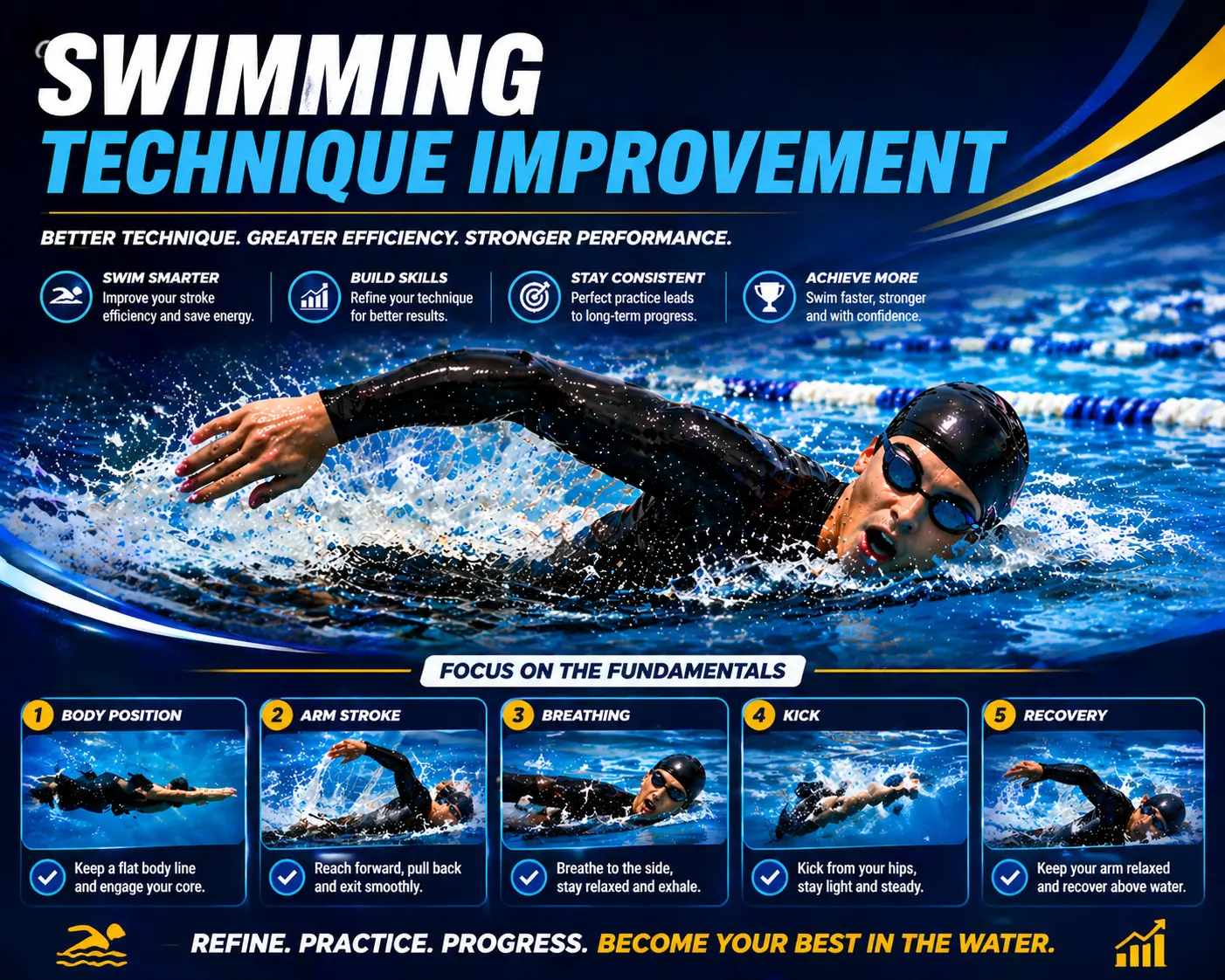
Introduction
Swimming can feel frustrating when no matter how much you practice, your lap times don’t improve and you feel exhausted halfway through a session. I’ve seen this with swimmers of all levels, from beginners struggling to breathe efficiently to seasoned athletes stuck at a performance plateau. What this really means is that strength alone isn’t enough; your body needs the right technique to move through water efficiently. That’s why Swimming Technique Improvement isn’t just a nice-to-have, it’s essential for speed, endurance, and confidence in the pool.
Over the years coaching swimmers and analyzing my own performance, I’ve learned that small adjustments in body rotation, breathing, and arm pull make the biggest difference. In this guide, I’ll share insights and drills that actually work based on real practice and observation, so you can address common pain points, correct mistakes, and swim smarter from day one.

Body Position: How to Glide Smoothly
Your body is like a boat. The straighter and more horizontal you are, the less drag slows you down.
- Keep your head in line with your spine. Don’t lift it too high; look slightly forward.
- Maintain a streamlined posture. Your hips and legs should stay close to the surface.
- Reduce unnecessary movement. Avoid swaying side to side or bouncing up and down.
Drills to practice body position:
- Kickboard float: Hold a kickboard and focus on keeping your body straight.
- Streamline push-offs: Push off the wall with arms extended and glide as far as possible.

Body Rotation: Linking Arms, Legs, and Breathing
Body rotation ties everything together. Your shoulders and hips should roll together as you swim. This helps you pull more water, breathe easily, and keep your legs near the surface.

Drills to practice rotation:
- Side rotation drill: Swim on your side with one arm extended, focusing on rolling your body with each stroke.
- Single-arm rotation drill: Use one arm at a time and feel how your body turns with each pull.
Breathing Technique: Don’t Waste Energy
Breathing is more than taking air. If done wrong, it slows your stroke and tires you out.
Breathing mistakes are especially common in freestyle. Our Freestyle Swimming Tips guide explains additional ways to improve breathing rhythm and stroke timing.

- Exhale underwater. Continuous exhaling helps you avoid gasping.
- Rotate your head with your body. Don’t lift your head alone.
- Keep a rhythm. Every two or three strokes, depending on your comfort.
Drills to improve breathing:
- Side-kick drill: Kick on your side with one arm extended and practice breathing without lifting your head.
- Bilateral breathing: Alternate sides every few strokes to balance your body and rotation.
Arm and Stroke Technique: Pull with Power
Your arms do most of the work. Using them correctly saves energy and propels you farther.
Many of these movement patterns are commonly taught during Swim Stroke Lessons, where swimmers learn how to improve their catch, pull, and recovery phase.

- High elbow catch: Enter the water with a high elbow to pull more effectively.
- Early vertical forearm catch: This phase creates most of the forward push.
- Full pull: Pull through the water all the way to your hip.
- Recover relaxed: Move your arm above water without tension.
Drills to practice arm technique:
- Single-arm drill: Swim using one arm at a time to focus on pull mechanics.
- Catch-up drill: One arm waits at the front until the other completes the stroke.
- Sculling drill: Move your hands back and forth under the water to feel resistance.
Timing Between Breath, Kick, and Pull
Proper timing connects breathing, kicking, and arm movement.
- Breathe as your body rotates and the pulling arm opens your side.
- Kicks should support this rotation. Use 2-beat kick for long-distance swimming or 6-beat kick for speed.
- Coordinated motion reduces drag and saves energy.
Drills for timing:
- Bilateral breathing drill: Alternate sides every few strokes to match rotation and kick rhythm.
- Kick and stroke sync drill: Focus on matching kick beats with arm pull and rotation.
Kicking: Small Movements, Big Impact
Your legs aren’t just decoration. Kicks keep your body horizontal and assist with rotation.

- Flutter kick for freestyle and backstroke: Keep movements small and fast.
- Breaststroke kick: Push water back using a whip-like motion.
- Consistent rhythm: Don’t kick too hard; aim for steady, controlled movement.
The flutter kick discussed here is also used in Backstroke Techniques, where steady kicking helps maintain balance and body position.
Drills to improve kicking:
- Vertical kicking: Stay upright in water and kick to build strength.
- Kickboard sprints: Use a kickboard and focus on proper leg motion.
Turns and Finishes: Save Seconds Every Lap
Turns and finishes can make a big difference in lap times.

- Flip turns: Tuck, rotate quickly, and push off in a streamlined position.
- Open turns for breaststroke: Turn efficiently without losing momentum.
- Strong finishes: Extend your last stroke fully into the wall.
Drills for turns:
- Wall approach practice: Focus on proper foot placement and rotation.
- Push-off glides: Maximize distance off the wall in a streamlined position.
Drills Organized by Skill
Consistent practice is the key to technique development. These swimming stroke drills help reinforce proper movement patterns and build muscle memory over time.
Body Position: Kickboard float, streamline push-offs
Breathing: Side-kick drill, bilateral breathing
Arms/Stroke: Single-arm drill, catch-up drill, sculling drill
Kicking: Vertical kick, kickboard sprints
Turns: Wall approach practice, push-off glides
Rotation & Timing: Side rotation drill, single-arm rotation, kick-stroke sync drill
Progress Tracking and Measurement
Track your progress to see real improvement:
- Count strokes per lap; fewer strokes usually mean better efficiency.
- Time your laps and note improvements weekly.
- Record videos to analyze form and compare over time.
Better technique often leads to improved stamina because less energy is wasted during each stroke. This connection is explained further in our guide on how to Improve swimming endurance.
Common Mistakes: Specific Fixes
- Head too high: Hips drop and arms lose alignment. Keep head in line with spine.
- Over-kicking: Body rotation becomes unbalanced. Keep kicks steady and controlled.
- Pull too late: Forward propulsion decreases. Focus on early vertical forearm catch.
- Poor rotation: Arms and breathing lose coordination. Practice drills that rotate shoulders and hips together.
Named Drills for Muscle Memory and Feel
- Fingertip drag: Drag fingertips along the water during recovery to encourage high elbow.
- Streamline push-offs: Push off the wall with a tight streamline to practice body alignment.
- Vertical kicking: Stay upright and kick to improve leg power and balance.
- Sculling: Small hand motions to develop catch and water feel.
Weekly Improvement Plan (Beginner to Advanced)
Before starting technique drills, spend a few minutes following proper Swimming Warm-Up Routines to prepare your muscles and improve mobility in the water.
Week 1-2: Body position, rotation, breathing
Week 3-4: Stroke technique drills, kicking practice
Week 5-6: Turns, finishes, timed laps
Ongoing: Track progress, record videos, analyze your stroke
Key Takeaways
- Keep your head aligned and body streamlined
- Rotate shoulders and hips together
- Exhale underwater and breathe with rotation
- Focus on early vertical forearm catch and full pull
- Sync your kick with arm pull and rotation
- Track stroke count, lap times, and video yourself for feedback
Drill Summary Table
| Week | Focus Area | Drills | Notes |
|---|---|---|---|
| 1–2 | Body Position & Breathing | Kickboard float, Side-kick drill | Focus on alignment and exhaling underwater |
| 3–4 | Stroke & Arm Pull | Single-arm drill, Catch-up drill, Sculling | Feel water resistance and maintain high elbow |
| 5–6 | Kicking & Turns | Kickboard sprints, Vertical kick, Flip turns | Coordinate kicks with rotation and breathing |
| Ongoing | Timing & Progress Tracking | Bilateral breathing, Kick-stroke sync drill, Video analysis | Track strokes, lap times, and adjust technique |

Frequently Asked Questions
1. How long will it take to improve my swimming technique?
Most swimmers notice improvement in 4–6 weeks with consistent practice. Beginners see gains in body position and breathing first, while intermediates improve stroke efficiency and speed gradually.
2. Which drills should I focus on first?
Start with body position and breathing drills like kickboard float and side-kick drill. Add stroke drills once comfortable. Kicking and turns come later in weeks 3–6.
3. How can I track my progress effectively?
Track stroke count, lap times, and record videos to compare form weekly.
4. Do I need a coach to improve my technique?
Not necessarily. Structured drills, video self-review, and consistent practice are often enough. Coaches are useful for personalized feedback.
5. What common mistakes should I watch out for?
Key mistakes include lifting the head too high, over-kicking, poor rotation, and late arm pull. Small adjustments fix these efficiently.
Final Thoughts
Improving your swimming technique isn’t an overnight fix. I’ve experienced firsthand how focusing on one skill at a time, like mastering your catch or coordinating your kick with your breath, can transform efficiency and reduce fatigue. By consistently applying these drills and tracking progress, swimmers of all levels can see measurable improvement.
The key is to approach Swimming Technique Improvement methodically and with awareness. Use the drills, track your form, and make small adjustments gradually. My personal experience shows that swimmers who commit to structured practice, not just longer sessions, gain the most sustainable progress. Stick with it, and your strokes will feel smoother, your energy will last longer, and your confidence in the pool will grow.

