



Introduction
Most swimmers struggle with the same frustrating problems: laps feel endless, your freestyle might be inefficient, your backstroke rotation stiff, or your butterfly tires you out after only a few strokes. You may feel stuck, like nothing you do in the pool is improving your technique. That’s exactly why Swimming Stroke Drills are so important. They target weak points in your stroke, help correct mistakes, and build confidence in the water.
From my own experience as a coach and competitive swimmer, I’ve seen beginners, intermediates, and advanced swimmers face the same barriers. The right drills, practiced consistently, improve body position, arm mechanics, and stroke efficiency. This guide shares drills that work, explains why they’re effective, and shows how to integrate them into every practice, so you can swim smarter, not just harder.

Key Takeaways
- Swimming stroke drills target specific flaws in your technique.
- Consistent practice improves efficiency, speed, and endurance.
- Each stroke like freestyle, backstroke, breaststroke, butterfly has unique drills.
- Tracking your progress and following drill sequences builds confidence.
- Beginner to advanced progressions ensure safe, effective improvement.

Stroke Mechanics Fundamentals
Before doing drills, understanding stroke basics improves results:
- Freestyle & Backstroke: Keep your body flat, rotate shoulders and hips, maintain neutral head position.
- Breaststroke: Coordinate arm pull with leg kick, glide slightly after each kick, keep body horizontal.
- Butterfly: Use fluid undulating motion from the hips, keep arms moving together, time dolphin kick with pull.
Freestyle Drills
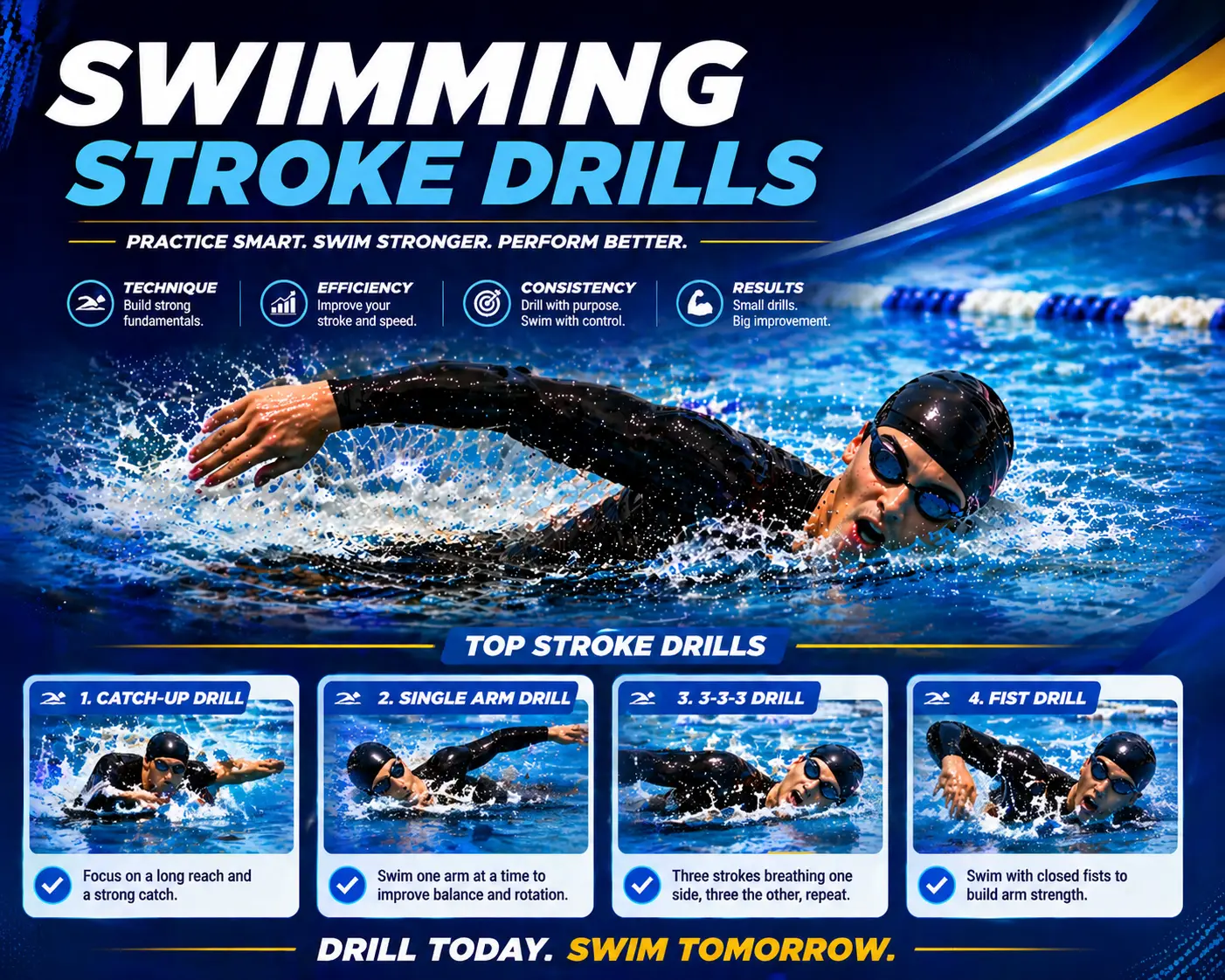
Catch Up Drill
- Purpose: Timing, arm coordination, balance.
- How to Do It: Swim freestyle using one arm while the other stays extended. Alternate arms.
- Common Mistake: Dropping elbow. Keep elbows high, core tight.
This drill is especially useful for swimmers working on freestyle timing, balance, and a smoother arm recovery.
Fingertip Drag Drill
- Purpose: High elbow recovery, rotation
- How to Do It: Drag fingertips along water during recovery.
- Tip: Keep body straight and shoulders relaxed.
One Arm Freestyle Drill
- Purpose: Balance, arm strength, stroke correction
- How to Do It: Swim one arm at a time, switch after 25 meters.
- Tip: Reach fully and rotate body.
Backstroke Drills

Single Arm Backstroke Drill
- Purpose: Body rotation, arm technique
- How to Do It: Swim with one arm, keep body straight.
Consistent practice can help swimmers develop better body rotation and improve overall backstroke techniques.
Backstroke Kick Drill
- Purpose: Leg strength, horizontal line
- How to Do It: Kick from hips, legs straight, toes pointed. Use board or not.
Additional Backstroke Variations
- Gallop Backstroke: Improves rotation and timing
- Rotation Hesitation Drill: Teaches control
Breaststroke Drills
Pull Kick Glide Drill
- Purpose: Timing between arms and legs
- How to Do It: Pull, kick, then glide
Sculling Drill
- Purpose: Water feel, propulsion
- How to Do It: Figure-eight motion in front of chest
Additional Breaststroke Variations
- Breast Kick on Back: Kick power, body line
- Timing 3-2-1 Drill: Arm-leg coordination
Butterfly Drills

Dolphin Kick Drill
- Purpose: Rhythm, core strength
- How to Do It: Legs together, kick from hips, arms at sides
Many swimmers use this drill to improve rhythm and reduce wasted energy during butterfly swimming.
One Arm Butterfly Drill
- Purpose: Timing, shoulder protection
- How to Do It: Swim one arm at a time, switch after each lap
Additional Butterfly Variations
- Single-Arm Butterfly with Tuck: Shoulder safety, rhythm
- Vertical Dolphin Kicks: Core & kick strength
Using Drills in Practice
Structure your swim session:
- Warm-Up: Begin with a proper swimming warm-up before starting technique drills to prepare your muscles and improve movement quality.
- Drill Set: 10-20 minutes, 2-3 drills per stroke.
- Main Set: Full stroke laps focusing on technique.
- Cool Down: 5 minutes easy swimming.
IM (Individual Medley) Drill Sequence
| Set | Drill | Stroke |
|---|---|---|
| 1 x 25m | Catch-Up | Freestyle |
| 1 x 25m | Single-Arm | Backstroke |
| 1 x 25m | Pull-Kick-Glide | Breaststroke |
| 1 x 25m | Dolphin Kick | Butterfly |
| Repeat 2–3 rounds | Mix above drills | IM |
Drill Summary Table
| Stroke | Drill | Purpose | Skill Level | Common Mistakes |
|---|---|---|---|---|
| Freestyle | Catch-Up | Timing & coordination | Beginner | Dropping elbow |
| Freestyle | Fingertip Drag | High elbow & rotation | Beginner → Intermediate | Poor rotation |
| Freestyle | One-Arm | Balance & arm strength | Intermediate | Not rotating body |
| Backstroke | Single-Arm | Rotation & technique | Beginner → Intermediate | Body not straight |
| Backstroke | Kick Drill | Leg strength & horizontal | Beginner | Hips dropping |
| Breaststroke | Pull-Kick-Glide | Arm-leg timing | Beginner | Short glide |
| Breaststroke | Sculling | Propulsion & feel | Beginner → Intermediate | Incorrect hand angle |
| Butterfly | Dolphin Kick | Rhythm & core | Beginner → Intermediate | Kicking from knees |
| Butterfly | One-Arm | Timing & shoulder safety | Intermediate | Arm too low |

Problem-Focused Drill Tips
- Breathing Issues: Use fingertip drag or one-arm drills
- Shoulder Strain: Single-arm drills, limit reps, focus on rotation
- Kick Weakness: Kickboard drills (freestyle/back), dolphin kick (butterfly)
- Body Alignment: Sidekick or sculling drills improve horizontal line
Common Questions About Swimming Stroke Drills
1. How often should I practice swimming stroke drills?
For most swimmers, 2-3 sessions per week, 20-30 minutes per session, is ideal. Beginners should focus on basic drills first, while advanced swimmers can integrate multiple drills into longer sessions.
2. Which drills should I start with as a beginner?
Start with foundational drills like Catch-Up for freestyle, Kick Drill for backstroke, Pull-Kick-Glide for breaststroke, and Dolphin Kick for butterfly. These drills teach timing, body position, and rhythm without overloading your muscles.
3. How do I progress from beginner to advanced drills?
Use the progression chart: begin with basic drills, then move to intermediate drills like Fingertip Drag, Single Arm Backstroke, Sculling, and One Arm Butterfly. Advanced drills include One Arm Freestyle, Gallop Backstroke, Breast Kick on Back, and Vertical Dolphin Kicks. Track progress and gradually increase reps or distance.
4. Can swimming stroke drills prevent injuries?
Yes. Targeted drills improve body mechanics, strengthen shoulders, core, and legs, and reduce inefficient movements that often cause strain. Always focus on correct technique and avoid overtraining to prevent injuries.
5. How do I integrate drills into my regular swim workout?
Structure your session:
- Warm-Up: 5-10 minutes easy swimming
- Drill Set: 10-20 minutes with 2-3 drills per stroke
- Main Set: Full stroke laps with focus on form
- Cool Down: 5 minutes easy swimming
This approach ensures drills improve your stroke while maintaining endurance and pace.
Final Thoughts
Over years of coaching and swimming, I’ve seen one truth: swimmers who practice targeted Swimming Stroke Drills consistently improve faster, reduce injuries, and gain more confidence than those who just swim laps. My personal experience using single arm and catch up drills transformed my freestyle it became smoother, more balanced, and less tiring.
The real value is understanding how each drill corrects flaws, builds strength, and improves timing. By following these drills, tracking progress, and practicing deliberately, swimmers of any level, beginner or advanced it can improve technique, swim efficiently, and enjoy the water with confidence.

