



Introduction
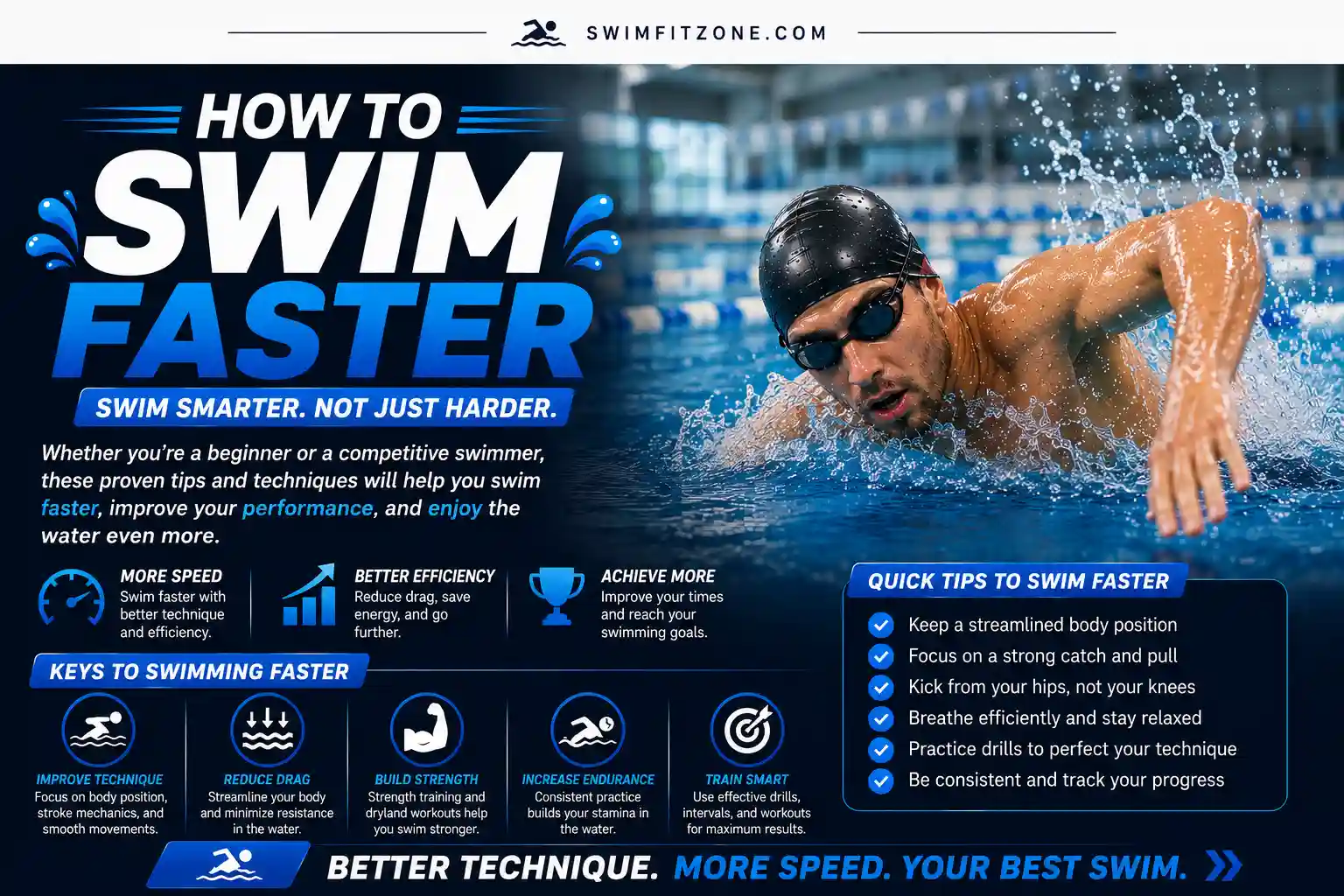
If you’re searching for how to swim faster, you may feel like you’re putting in plenty of effort without seeing better results. Maybe you get tired after a few laps, struggle to keep up with other swimmers, or feel stuck at the same speed. The truth is that swimming faster usually comes from improving your technique instead of simply working harder. Small changes in body position, breathing, and stroke efficiency can make a noticeable difference.
From my coaching experience, I’ve seen many swimmers improve their speed after fixing just a few basic mistakes. Instead of trying to swim harder, they focused on better technique and consistent practice. In this guide, you’ll learn practical methods that can help you swim faster, move more efficiently through the water, and build confidence every time you train.

Key Takeaways
- Swimming faster starts with better technique instead of more effort.
- A flat body position and good streamline reduce drag.
- A strong catch, efficient pull, and steady kick improve propulsion.
- Focus on stroke efficiency before increasing stroke rate.
- Practice drills and interval training consistently.
- Track your progress using lap times and stroke count.
Why You Might Be Swimming Slowly
Many swimmers believe they simply need to swim harder to become faster. That is rarely the real answer. Water creates much more resistance than air, so even small technique mistakes can slow you down.
You may notice that you work just as hard as other swimmers, yet they continue to pull away. In most cases, the difference is not fitness. It is efficiency.
Ask yourself these questions:
- Do your legs sink below the surface?
- Do you lose your rhythm when breathing?
- Do you feel exhausted after only a few laps?
- Do you take many strokes to finish one length?
- Do you slow down after every turn?
If you answered yes to any of these questions, your technique is probably limiting your speed more than your strength. Learning proper swimming stroke techniques can help you correct these common mistakes and make every stroke more effective.
What Makes a Swimmer Fast?
Swimming speed depends on how efficiently you move through the water.
A faster swimmer does three things well.
- Reduces resistance.
- Creates more forward movement.
- Uses energy efficiently.
Many beginners make the mistake of moving their arms faster while ignoring their technique. This usually creates more splashing and wastes energy. Instead, build a strong foundation first. Once your technique improves, increasing your speed becomes much easier.
Whether you swim for fitness, local competitions, or personal improvement, these same principles apply.
The Three Keys to Swimming Faster
Reduce Drag
Drag is the force that slows you down in the water. The less resistance you create, the easier it becomes to move forward.
Increase Propulsion
Propulsion is the force that pushes you through the water. A strong catch, an effective pull, and a balanced kick all help move you forward with less wasted effort.
Improve Efficiency
Efficiency means getting more distance from every stroke while using less energy. Swimmers who focus on efficiency often become faster without feeling more tired.
Find Your Biggest Speed Limiter
Every swimmer has one weakness that affects speed the most. Finding it first helps you improve much faster.
| If This Sounds Like You | Focus On |
|---|---|
| My legs sink while swimming. | Body position |
| I get tired after a few laps. | Breathing and endurance |
| I take too many strokes. | Stroke efficiency |
| I lose speed after every turn. | Streamline |
| My pull feels weak. | Catch and pull |
Choose one area to improve first instead of trying to fix everything at once.
Improve Your Body Position

Your body position has one of the biggest effects on your swimming speed. A flat body moves through the water much more easily than one with sinking hips or bent legs.
Keep your head in a neutral position and look toward the bottom of the pool instead of straight ahead. This helps keep your hips close to the surface and reduces resistance.
Keep your core engaged throughout each lap. A strong core helps your body stay balanced and prevents unnecessary movement from side to side. If you mainly swim freestyle, refining your freestyle swimming technique can improve your body alignment and help you move through the water more efficiently.
From my coaching experience, many swimmers begin swimming faster simply by correcting their head position. Once their hips rise closer to the surface, every stroke becomes smoother and requires less effort.
Reduce Drag
Every movement in the water creates some resistance, but good technique keeps it to a minimum.
To reduce drag:
- Keep your body long and balanced.
- Avoid wide kicks that create extra resistance.
- Enter your hand into the water in line with your shoulder.
- Stay relaxed instead of tensing your muscles.
Small improvements in these areas can save energy during every lap.
Improve Your Streamline Off Every Wall
Many swimmers lose free speed after every push off because they rush back into their stroke.
- Instead, hold a tight streamline.
- Place one hand over the other.
- Squeeze your arms against your ears.
- Keep your head between your arms.
- Tighten your core.
- Point your toes.

Stay streamlined until your speed naturally slows, then begin your first stroke. Practicing this during every session helps you carry more speed without using extra effort.
By building a strong body position, reducing drag, and improving your streamline, you create the foundation needed for faster swimming. The next step is learning how to generate more power with your catch, pull, kick, and breathing while keeping every stroke efficient.
Improve Your Catch and Pull

A strong catch and pull help you move forward with every stroke. Many swimmers move their arms through the water without holding enough water, which reduces speed.
Reach forward and begin your catch with a slightly bent elbow. Press the water backward instead of downward. Finish your pull near your hip before starting your recovery.
Keep these tips in mind:
- Keep your elbow higher than your hand during the catch.
- Pull in a smooth path under your body.
- Finish every stroke completely.
- Avoid rushing your pull.
A better catch gives you more propulsion without using extra energy. Practicing focused swimming stroke drills is one of the best ways to strengthen your catch and improve your pull during every lap.
Improve Your Kick
Your kick should support your body position and add steady propulsion. Bigger kicks do not always make you faster. In many cases, they waste energy.
Kick from your hips instead of your knees. Keep your legs close together and point your toes naturally. Your kicks should be small, quick, and controlled.
A balanced kick helps you stay streamlined and maintain your rhythm throughout each lap. If you are still building confidence in the water, learning the best swimming strokes for beginners can also help improve your kicking technique and overall coordination.
Breathe Without Slowing Down
Poor breathing often breaks your rhythm and slows your pace.
Instead of lifting your head forward, turn it gently to the side while keeping one eye in the water. Breathe in quickly and breathe out slowly while your face is underwater.
A smooth breathing pattern helps you stay relaxed and maintain better body position. If you are a beginner, breathing every two or three strokes is a good starting point. Taking structured swim stroke lessons can help you develop better breathing habits and improve your confidence in the water.
Increase Stroke Efficiency
Swimming faster is about making every stroke count.
Try to travel farther with each stroke while keeping a smooth rhythm. Avoid taking many short, rushed strokes because they waste energy.
Do not compare yourself with other swimmers. Focus on improving your own technique one session at a time. Small improvements each week often lead to faster lap times over the coming months.
Find the Right Stroke Rate
Stroke rate is the speed at which you complete your strokes.
If your stroke rate is too slow, you lose momentum. If it is too fast, your technique may break down and you become tired sooner.
Aim for a comfortable rhythm that matches your stroke length. As your technique improves, you can gradually increase your stroke rate without sacrificing good form.
Increase Your Distance Per Stroke
Distance per stroke is how far you travel with each stroke.
To improve it:
- Reach forward naturally.
- Hold the water during your catch.
- Finish each pull near your hip.
- Keep your body balanced.
Avoid gliding too long between strokes. A smooth and continuous stroke is usually faster than trying to stretch every movement.
Best Drills to Swim Faster

Practicing drills helps you improve specific parts of your technique.
| Drill | Main Benefit |
|---|---|
| Catch Up Drill | Improves body position and stroke timing |
| Sculling Drill | Develops a stronger catch |
| Fingertip Drag Drill | Improves arm recovery |
| Side Kick Drill | Builds balance and breathing control |
| Vertical Kick Drill | Strengthens kicking technique |
Choose one or two drills during each workout. Focusing on a few skills at a time is more effective than trying to improve everything in one session.
Use Interval Training to Build Speed
Swimming at the same pace every workout can slow your progress. Interval training teaches your body to swim faster while maintaining good technique.
Try this simple workout:
- Warm up with 200 meters of easy swimming.
- Swim 8 × 25 meters at about 90 percent effort.
- Rest for 30 seconds after each repeat.
- Cool down with 100 meters of easy swimming.
As you become stronger, reduce your rest time or increase the number of repeats. Adding different swimming workout routines throughout the week can help you continue building speed while avoiding training plateaus.
Weekly Swim Faster Training Plan
| Day | Focus |
|---|---|
| Monday | Body position and technique |
| Tuesday | Interval training |
| Wednesday | Easy recovery swim |
| Thursday | Catch, pull, and kick drills |
| Friday | Sprint practice |
| Saturday | Endurance swim |
| Sunday | Rest and recovery |
Beginners should complete these sessions at a comfortable pace. Intermediate swimmers can gradually increase the intensity as their fitness improves. Starting each session with proper swimming warm up routines prepares your muscles for training and lowers the risk of injury.
How to Measure Your Progress
Track your results every few weeks instead of judging your progress after every workout.
Measure:
- 50 meter swim time
- 100 meter swim time
- Stroke count per length
- Recovery time between sets
- Number of training sessions each week
Keeping a simple training log makes it easier to see your improvement and stay motivated. If your goal is to swim longer without slowing down, learning how to improve swimming endurance can help you maintain your speed over greater distances.
Common Mistakes That Keep Swimmers Slow
Many swimmers repeat the same mistakes without realizing it.
Avoid these habits:
- Looking forward instead of down.
- Holding your breath underwater.
- Taking short, rushed strokes.
- Kicking too hard.
- Skipping drills.
- Swimming every workout at the same pace.
- Ignoring recovery after hard sessions.
Correcting even one of these mistakes can make a noticeable difference.
Quick Checklist Before Every Swim
Before you start your workout, check these points:
- Keep your head in a neutral position.
- Tighten your core.
- Stretch into every stroke.
- Hold the water during your catch.
- Kick from your hips.
- Breathe smoothly.
- Stay relaxed.
- Focus on good technique before increasing speed.
Using the right swimming gear can also improve your comfort and help you focus on your technique during every training session.

Final Thoughts
Learning how to swim faster takes patience and consistent practice. Focus on improving one skill at a time instead of trying to change everything at once. As your technique becomes smoother and more efficient, your speed will improve naturally.
From my coaching experience, the swimmers who improve the most are not always the strongest when they begin. They are the ones who stay consistent, keep practicing the basics, and track their progress over time. Stay patient, celebrate every improvement, and trust the process. Those small gains can turn into faster lap times and greater confidence every time you swim. If you plan to test your new speed in races, learning more about training for swimming competitions can help you prepare with confidence.

